
Pennycress is an oilseed winter crop that can be harvested and bioprocessed to produce sustainable aviation and diesel fuels. Nebraskan Jason Thomas, Ph.D., founded The Pennycress Company in 2023 to bioengineer pennycress seeds and connect the supply chain from farmer to biorefinery.
Thomas’ goal is to make agriculture more profitable and sustainable while supporting rural economies and climate solutions. He contracted with Nebraska Innovation Campus (NIC) in Lincoln for laboratory space and soon learned about NESTIP support through Nebraska EPSCoR, also located at NIC.
The Nebraska Engineering, Science and Technology Internship Program (NESTIP) offers up to $5,000 through a 50% cost-share for businesses hiring undergraduate or graduate students for project-based paid internships in science, technology, engineering and mathematics (STEM) roles. Nebraska EPSCoR conducts NESTIP with funding from the U.S. National Science Foundation to grow the state’s research ecosystem.
Thanks to NESTIP funding, intern Meghan Burwell became Pennycress’ first employee in late 2025. Burwell is a University of Nebraska–Lincoln undergraduate studying agronomy and horticulture with a minor in business.
Burwell said her Pennycress internship gave her wide-ranging experience, from the lab to the greenhouse to startup business practices.
“I had taken a genetics course for my AgroHort degree, and worked with lettuce plants in that class,” said Burwell, who expanded that knowledge with Pennycress. She tended hundreds of Pennycress Co. plants at UNL’s East Campus Greenhouse and took observations on what plants had useful commercial traits such as yield, flowering time, and germination rates. Maintaining and collecting data on these plants is critical to the breeding goals of The Pennycress Company.
She also used bioinformatics tools to compare DNA of pennycress to well-studied plant species such as canola and Arabidopsis, the “lab rat” of the plant science world. Making these comparisons serves as a blueprint to know what genes to change in pennycress and how to change them.
After finding what genes to edit, Thomas and Burwell also used CRISPR genome editing tools to improve their plants’ traits. This is done by transferring novel CRISPR DNA into the plant tissues to manipulate and enhance pennycress's oil production.
“I had many responsibilities with Pennycress,” Burwell said, smiling. By mid-2026, she moved on to work for another local ag company, but values her startup experience.
Thomas said NESTIP funding has made it easier to hire another intern as he keeps The Pennycress Company moving forward.
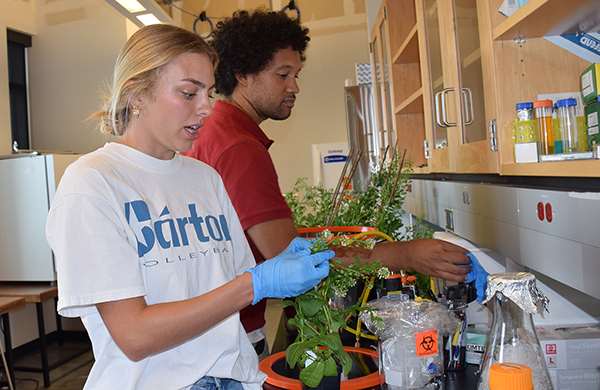
Photo caption: Above, Meghan Burwell and Jason Thomas work in lab space of The Pennycress Co. in the Biotech Connector, part of Nebraska Innovation Campus.